
NVT-HMS CPsystem
Platform for Vibration Monitoring and Crash Preventing in Test Bench Applications
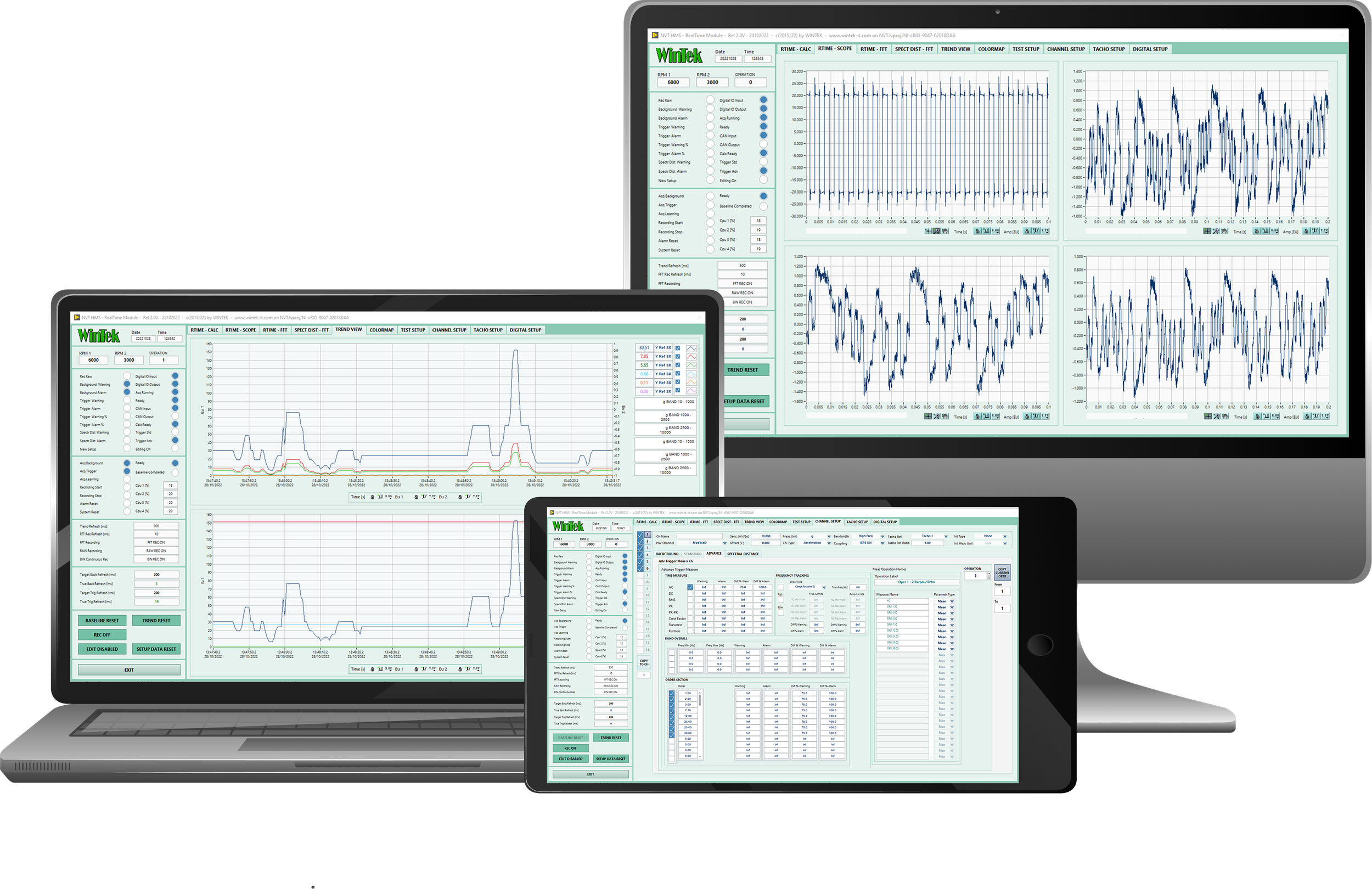
The NVT-HMS CPsystem is a scalable platform for vibration monitoring, predictive diagnostics, and crash preventing on test benches. Designed for automotive applications but suitable for a wide range of mechanical setups, it integrates real-time analysis, spectral evaluation (Spectral Distance), maneuver-based test management, and communication through industrial protocols. It ensures early anomaly detection, advanced data acquisition, and full protection of both the component and the test bench throughout every phase of the test.
-
The NVT-HMS CPsystem is a professional solution developed for advanced control of vibration testing in the automotive sector, with applications on engine test benches, electric/hybrid powertrains, gearboxes, and transmissions.
Its scalable architecture, based on cRIO, cDAQ, and PXI technologies, enables the management of more than 64 channels, ensuring high precision and robustness even in the most demanding test cycles. -
Although designed for the automotive industry, NVT-HMS CPsystem is effectively used in countless test bench applications, including rotating machinery, actuators, gear reducers, mechanical components, and electromechanical devices.
Its configuration flexibility and compatibility with industrial protocols (CAN, MODBUS, OPC UA) allow seamless integration into any test architecture. -
The system operates through three coordinated monitoring modes:
Background: continuous supervision of the main parameters.
Advanced: maneuver-based management with dedicated parameters for each phase.
Spectral Distance – Crash Preventing: spectral analysis to predictively detect deviations and anomalies, preventing failures and damage to both the unit under test and the test bench.
-
NVT-HMS CPsystem performs analyses in the time domain (RMS, Peak, Peak-to-Peak, Crest Factor, Kurtosis, etc.) and in the frequency domain (Band Overall, order analysis, frequency tracking, Spectral Distance).
Warning and alarm thresholds can be configured as absolute values or as relative deviations from a reference condition. -
Real-time trend-view
Continuous logging
RAW and FFT acquisition on event
Post-processing and advanced analysis via the NVT-HMS-PPRO software suite
-
1. General Architecture
The NVT-HMS RealTime Module software is installed on a National Instruments CompactRIO (cRIO) data acquisition system.
cRIO systems are Real-Time platforms with built-in processing capabilities and can be configured according to application needs.
2. Hardware Configuration
Real-Time Chassis:
Model NI cRIO-9047.
Supports installation of up to 4 C-Series modules.
Analog Acquisition Modules:
From 3 to 6 NI-9232 modules.
SUPPORTED SIGNAL TYPES: accelerometers, microphones, tachometer sensors, etc.
TOTAL CHANNEL COUNT: 9 to 18 channels.
Digital I/O Module:
Model NI-9375.
Used for digital communication with the Puma test bench control system.
CAN Module:
Model NI-9862 (X-Net).
Function: transmission and reception of test bench parameters (RPM values, torque, N operations, etc.).
3. cRIO System Features
High-performance and highly reliable control and data acquisition system.
Combines:
An open Real-Time architecture,
Compact, robust industrial I/O modules,
Hot-swappable modules.
4. System Configuration
Low-level cRIO system settings are managed through NI MAX (Measurement & Automation Explorer):
Configuration of static IP addresses (TCP/IP).
Setting of system date and time.
Verification of system health and operation.
Diagnostic tools for connectivity and hardware configuration.
5. Software Requirements
Mandatory NI MAX 2020 version.
Required installation of the NI CompactRIO 2020 add-on package to fully access the capabilities of cRIO systems.