
NVA - Modal Test
Experimental Modal Analysis System
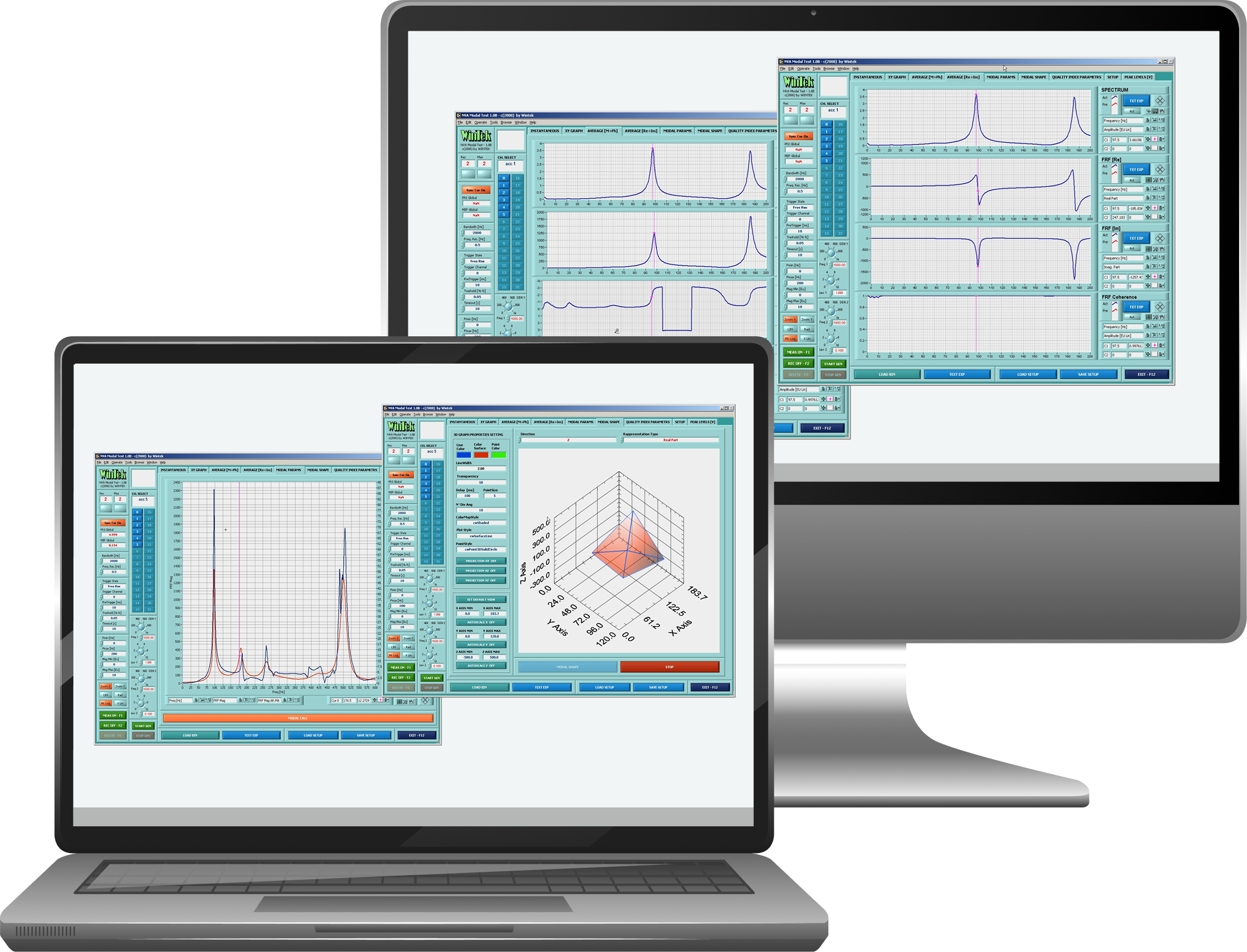
NVA-Modal Test is an advanced system for experimental modal analysis of mechanical structures and systems, designed for accurate identification of modal parameters through impact testing with an instrumented hammer or multi-shaker excitation.
The system enables acquisition, processing, and analysis of frequency response functions (FRFs) between the excitation force and the structural response measured by accelerometers, providing a complete solution for research, development, validation, and structural testing activities.
-
NVA-Modal Test is composed of:
Multichannel acquisition front-end, also available in portable configurations
Modal test transducers (instrumented hammer, accelerometers, strain gauges)
Signal generation system for shaker excitation
Control computer (notebook or embedded controller)
NVA-Modal Test application software for acquisition and analysis
The system can be implemented on different hardware platforms, ensuring scalability and flexibility according to the number of channels and the application requirements.
-
Compatibility with cDAQ, cRIO, and PXI multichannel systems
From 4 to 32 (or more) simultaneous input channels
24-bit A/D converters with high dynamic range
Sampling rate up to 51.2 kS/s per channel
Programmable anti-aliasing filters
Dynamic range greater than 110 dB
Integrated power supply for IEPE / ICP sensors (24 V – 4 mA)
TEDS support for automatic sensor recognition
These features ensure reliable measurements even on complex structures and low-response vibration levels.
-
Acquisition and Excitation
Free-run or triggered acquisition modes
Impact excitation using an instrumented hammer
Controlled excitation via electrodynamic shakers
Signal generation (sine, broadband, random) up to 8 independent output channels
Signal Processing
Time-domain analysis
FFT analysis with selectable windowing
FRF calculation and averaging
Normal Mode and Frequency Domain Techniques (FDT) analysis
Modal Parameter Extraction
Automatic identification of natural frequencies
Calculation of damping factors
Curve fitting using autoregressive (AR / ARMA) algorithms
Evaluation of:
Coherence
Real and imaginary parts
Measurement quality indicators (MIF, Phase Index)
-
FRF visualization (Magnitude, Phase, Real / Imaginary)
Comparative analysis across multiple measurement points
Mode shape animation and visualization
2D and 3D representations based on schematic geometry
Signal recording for post-processing analysis
Export of results to standard formats (TXT, CSV, ASCII)
-
Experimental modal analysis of mechanical structures
Identification of natural frequencies and damping ratios
FEM model validation and correlation
Testing of frames, beams, housings, mechanical components, and industrial structures
Vibration analysis in R&D environments
Structural testing and diagnostics
Academic and research laboratories
-
Complete hardware + software solution
High metrological accuracy
Scalable channel count
Suitable for laboratory and field testing
Full integration with the NVA software suite